
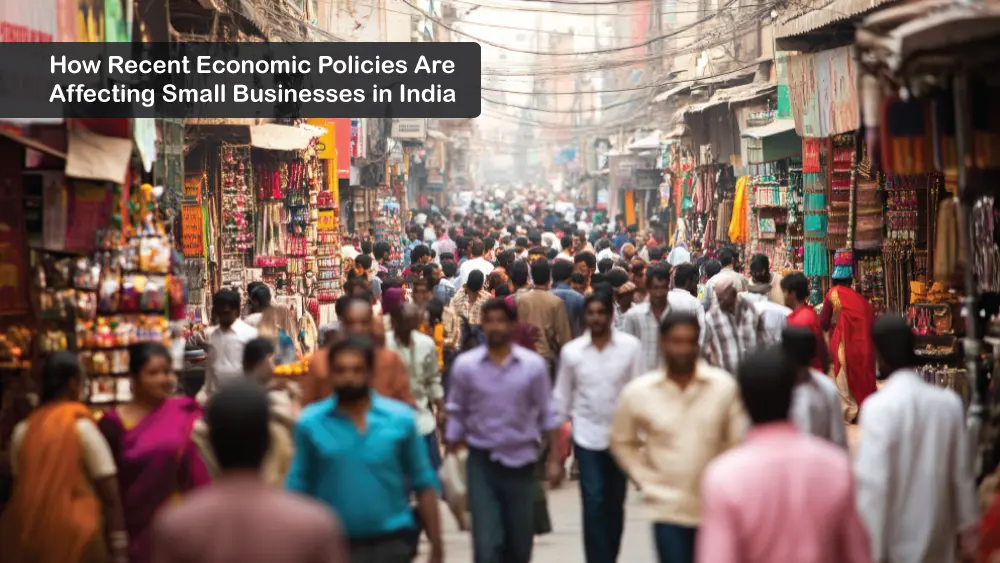
India’s small businesses-commonly known as Micro, Small, and Medium Enterprises (MSMEs)-form the backbone of the economy. They contribute nearly 30% to GDP and employ over 11 crore people, making them crucial for inclusive growth. In recent years, especially through Union Budget 2025–26 and 2026–27, the Indian government has introduced a series of economic policies aimed at strengthening this sector. However, while many policies offer growth opportunities, they also bring challenges that small businesses must navigate carefully. This in-depth article by Daily Political View explores how recent economic policies are shaping the future of small businesses in India.
Basic Understanding to MSMEs in India
MSMEs are often referred to as the engine of India’s economic growth. From local manufacturing units to small service providers, they play a critical role in:
- Employment generation
- Export growth
- Rural industrialization
- Innovation and entrepreneurship
Recent government policies aim to transform MSMEs into globally competitive enterprises while ensuring ease of doing business.
Overview of Recent Economic Policies
Over the past two years, several key economic reforms have been introduced:
Key Policy Highlights:
- Union Budget 2026–27 reforms
- Revised MSME classification thresholds
- Simplified GST compliance
- Equity funding and credit guarantee schemes
- Digital invoicing and automation initiatives
These policies focus on financial support, innovation, and regulatory simplification to boost MSME competitiveness.
Additionally, the government has shifted from a subsidy-driven approach to an investment-driven model, emphasizing long-term scalability.
Positive Impacts on Small Businesses
1. Improved Access to Credit
Access to finance has always been a major challenge for small businesses. Recent policies have addressed this by:
- Expanding credit guarantee schemes
- Introducing equity-based funding
- Promoting fintech lending solutions
For example, modifications in credit guarantee schemes are helping MSMEs acquire machinery and expand operations.
2. Simplified Taxation and Compliance
The introduction of simplified GST filing systems has reduced the compliance burden:
- Easier return filing
- Faster tax refunds
- Reduced reconciliation complexities
This allows small business owners to focus more on growth rather than paperwork.
3. Boost to Manufacturing and “Make in India”
Government initiatives are encouraging domestic manufacturing:
- National Manufacturing Mission
- Production-linked incentives
- Export promotion programs
These policies help small businesses integrate into global supply chains and scale production.
4. Increased Formalization
With over 7.3 crore MSME registrations, formalization is accelerating rapidly.
Benefits include:
- Access to government schemes
- Better credit opportunities
- Legal and financial security
Challenges Created by Policy Changes
While policies aim to empower small businesses, they also introduce new challenges.
1. Rising Compliance Pressure
Even with simplification, many small businesses struggle with:
- Digital tax systems
- Frequent regulatory updates
- Documentation requirements
2. Delayed Payments and Cash Flow Issues
A major concern remains delayed payments from large corporations and government agencies.
Recent reports indicate that many MSMEs face cash flow crises due to pending payments, threatening business survival.
3. Rising Input Costs
Global supply chain disruptions and inflation have led to:
- Increased raw material costs
- Higher transportation expenses
These factors reduce profit margins, especially for manufacturing MSMEs.
4. Credit Gap Still Exists
Despite improvements, a massive credit gap of ₹30 lakh crore persists in the MSME sector.
This limits growth for small businesses that lack collateral or financial history.
Sector-Wise Impact Analysis
1. Manufacturing Sector
- Benefited from government incentives and infrastructure development
- Facing challenges due to rising input costs
2. Service Sector
- Growth driven by digitalization and startup ecosystem
- Struggles with taxation and compliance complexity
3. Export-Oriented MSMEs
- Supported by export promotion missions
- Affected by global economic uncertainty
Digital Transformation and Compliance
Digitalization is at the core of recent policies.
Key Developments:
- E-invoicing systems
- Digital GST platforms
- Online Udyam registration
These initiatives improve transparency and efficiency but require digital literacy and investment, which can be difficult for small businesses.
Credit Access and Financial Inclusion
The government is actively promoting financial inclusion through:
- Credit Guarantee Fund Trust (CGTMSE)
- Prime Minister Employment Generation Programme (PMEGP)
- Equity-based funding models
These initiatives aim to reduce dependence on traditional loans and encourage innovation-driven growth.
Government Schemes Supporting MSMEs
Several schemes are designed to strengthen small businesses:
- PM Vishwakarma Scheme
- ASPIRE (Innovation and Entrepreneurship)
- MSME Champions Scheme
- Cluster Development Programs
These programs focus on:
- Skill development
- Technology adoption
- Market access
Future Outlook for Small Businesses
The future of MSMEs in India looks promising but complex.
Growth Drivers:
- Strong economic growth forecast (around 7%+)
- Government focus on manufacturing and exports
- Increasing digital adoption
Potential Risks:
- Global economic instability
- Inflation and cost pressures
- Policy implementation gaps
Overall, MSMEs are expected to transition from survival mode to growth mode, provided policy benefits reach them effectively.
Conclusion
Recent economic policies in India reflect a transformational shift toward empowering small businesses. From improved credit access to simplified compliance and digital integration, the government is building a strong foundation for MSME growth.
However, challenges like delayed payments, rising costs, and credit gaps continue to hinder progress. For small businesses, success will depend on their ability to adapt, innovate, and leverage government support effectively.
At Daily Political View, we believe that the evolving policy landscape presents both opportunities and challenges-making it essential for entrepreneurs to stay informed and proactive.
FAQs
How do recent economic policies benefit small businesses in India?
Recent policies provide easier access to credit, simplified tax compliance, and incentives for innovation and manufacturing growth.
What are the biggest challenges MSMEs face today?
Key challenges include delayed payments, rising costs, regulatory complexity, and limited access to credit.
How has the Union Budget 2026 impacted MSMEs?
It introduced financial support, simplified GST processes, and promoted digitalization and innovation to improve competitiveness.
What is the role of digitalization in MSME growth?
Digital tools improve efficiency, transparency, and compliance but require investment and technical knowledge.
Are government schemes effective for small businesses?
Yes, but their effectiveness depends on awareness, accessibility, and proper implementation at the grassroots level.
What is the future outlook for small businesses in India?
The outlook is positive, with strong growth potential driven by policy support, digital adoption, and global market opportunities.


