
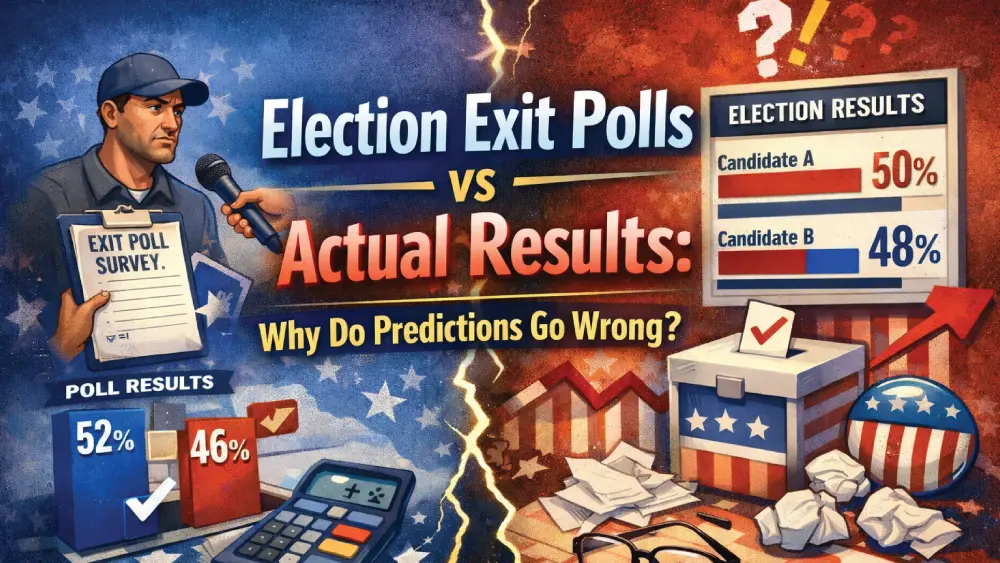
In the fast-paced world of elections, exit polls often dominate headlines even before the final votes are counted. They provide early insights into voter behavior and expected outcomes, shaping public opinion and political narratives. However, one recurring question continues to puzzle analysts and voters alike: Why do exit poll predictions sometimes go wrong? As elections become more complex and dynamic, understanding the gap between exit polls and actual results is crucial. On Daily Political View, we explore how evolving electoral landscapes, voter behavior, and data methodologies influence these predictions.
What Are Exit Polls?
Exit polls are surveys conducted with voters immediately after they cast their votes. The goal is to gather information about who they voted for and why. Unlike opinion polls conducted before elections, exit polls aim to reflect actual voting behavior rather than voter intentions.
These polls typically include questions about:
- Candidate choice
- Key issues influencing the vote
- Demographic details such as age, gender, and income
How Exit Polls Are Conducted
Exit polls rely on structured sampling methods. Pollsters select specific polling stations and approach voters as they exit. Participants are asked to fill out anonymous questionnaires or respond to interviewers.
Key steps include:
- Selecting representative polling stations
- Randomly sampling voters
- Weighting responses to reflect population demographics
- Aggregating data to predict overall results
Despite this systematic approach, several variables can affect accuracy.
Why Exit Polls Matter in Modern Elections
Exit polls play a significant role in shaping political discourse. They:
- Provide early indicators of election outcomes
- Help media organizations analyze trends
- Offer insights into voter demographics and issues
- Influence investor sentiment and public mood
However, their influence can also amplify errors when predictions deviate from actual results.
Key Reasons Why Exit Poll Predictions Go Wrong
1. Sampling Errors
One of the most common reasons for inaccurate exit polls is sampling error. Pollsters cannot survey every voter, so they rely on a subset. If the sample is not truly representative, the results can be skewed.
For example:
- Overrepresentation of urban voters
- Underrepresentation of rural or remote areas
- Bias in selecting polling stations
Even a small imbalance can significantly impact predictions.
2. Voter Reluctance and Misreporting
Not all voters are willing to share their choices honestly. Some may:
- Refuse to participate
- Provide false answers
- Avoid disclosing sensitive preferences
This phenomenon, often referred to as the “shy voter effect,” can distort poll results, especially in closely contested elections.
3. Last-Minute Voting Decisions
In many elections, a significant number of voters make their decisions at the last moment. Exit polls conducted earlier in the day may not capture these late shifts accurately.
Factors influencing last-minute decisions include:
- Breaking news
- Political speeches
- Social media trends
These sudden changes can create a gap between predicted and actual outcomes.
4. Regional and Demographic Variations
Elections are rarely uniform across regions. Different areas may have distinct political dynamics, cultural influences, and voting patterns.
Challenges include:
- Diverse linguistic and cultural groups
- Varying levels of political awareness
- Local issues overshadowing national narratives
If exit polls fail to capture these variations, predictions can be misleading.
5. Methodological Limitations
Every polling method has limitations. Issues such as questionnaire design, interviewer bias, and data weighting can introduce inaccuracies.
Common methodological challenges:
- Poorly framed questions
- Inadequate sample size
- Incorrect weighting of demographic groups
These factors can collectively lead to flawed predictions.
6. Media Pressure and Early Projections
Media organizations often compete to release predictions quickly. This rush can compromise the quality of analysis and data verification.
Consequences include:
- Premature conclusions
- Overinterpretation of partial data
- Sensationalized reporting
Inaccurate early projections can shape public perception even before final results are announced.
Case Studies: When Exit Polls Missed the Mark
Over the years, several elections have highlighted the limitations of exit polls. In many instances:
- Predicted winners lost by significant margins
- Close contests turned into landslides
- Regional outcomes contradicted national projections
These cases demonstrate that even well-conducted exit polls are not foolproof.
The Impact of Incorrect Exit Polls
When exit polls fail, the consequences can be far-reaching:
1. Public Confusion
Conflicting predictions can create uncertainty among voters and stakeholders.
2. Market Volatility
Financial markets often react to exit poll results, leading to fluctuations based on inaccurate data.
3. Political Narratives
Parties may prematurely claim victory or question credibility, affecting democratic processes.
The Role of Technology in Improving Accuracy
Advancements in technology are helping improve the reliability of exit polls:
- Data Analytics: Enhanced algorithms for better predictions
- AI and Machine Learning: Improved pattern recognition
- Digital Surveys: Faster and more accurate data collection
- Real-Time Monitoring: Continuous updates throughout the day
However, technology is not a complete solution. Human behavior remains unpredictable.
Are Exit Polls Still Reliable?
Despite their limitations, exit polls remain valuable tools. They provide:
- Immediate insights into voter behavior
- Context for understanding election outcomes
- Data for long-term political analysis
The key is to treat them as estimates rather than definitive results.
The Future of Election Predictions
As elections continue to evolve, so will prediction methods. Future trends may include:
- Integration of big data and behavioral analytics
- Increased use of mobile and online polling
- Greater transparency in methodologies
- Collaboration between polling agencies
On platforms like Daily Political View, the focus remains on interpreting these evolving trends responsibly and accurately.
Conclusion
Exit polls are an integral part of modern elections, offering early glimpses into voter sentiment. However, their predictions can go wrong due to a combination of sampling errors, voter behavior, methodological challenges, and external influences.
In an ever-evolving electoral landscape, it is essential to approach exit polls with a balanced perspective-valuing their insights while recognizing their limitations. Ultimately, only the official vote count provides the true verdict of democracy.
FAQs
What is the main difference between exit polls and opinion polls?
Exit polls are conducted after voters cast their votes, जबकि opinion polls are conducted before elections to gauge voter intentions.
Why do voters sometimes lie in exit polls?
Voters may feel uncomfortable sharing their choices due to privacy concerns, social pressure, or fear of judgment.
Are exit polls more accurate than pre-election surveys?
Generally, exit polls are considered more accurate since they reflect actual voting behavior, but they are still subject to errors.
Can exit polls influence election results?
While they do not directly affect results, they can influence public perception, media narratives, and market reactions.
How can exit poll accuracy be improved?
Improving sampling methods, increasing transparency, and using advanced data analytics can enhance accuracy.
Should voters trust exit poll predictions?
Exit polls should be seen as indicative rather than definitive. Final election results are always the most reliable source.


