
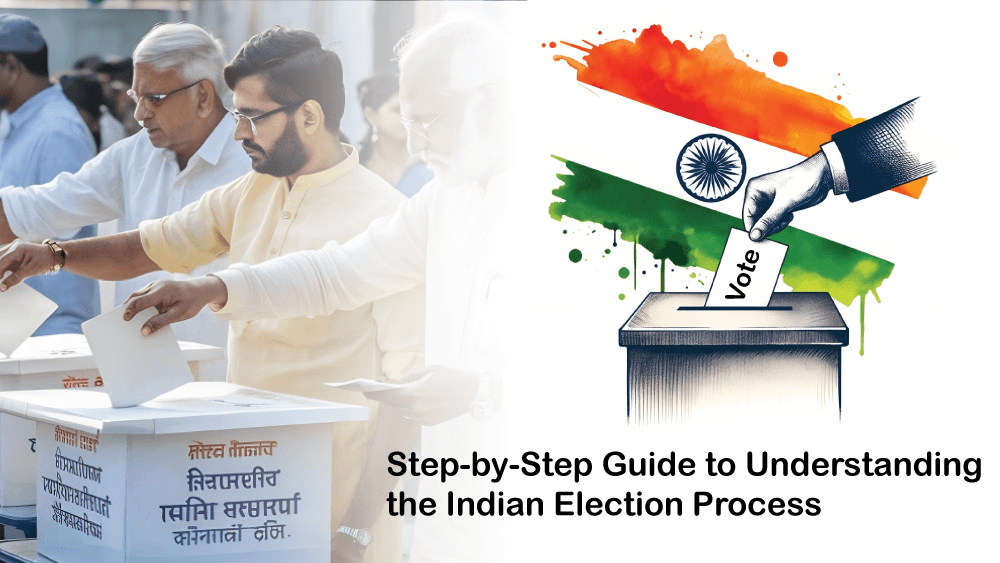
India, the world’s largest democracy, conducts one of the most complex and fascinating election processes globally. From voter registration to the final declaration of results, every stage reflects transparency, inclusiveness, and constitutional integrity. Governed by the Election Commission of India and rooted in the Constitution of India, the system ensures that every citizen has a voice. In this comprehensive guide, we will break down the Indian election process step by step, helping you understand how elections are conducted and why they are continuously evolving in today’s dynamic political landscape.
In brief: Indian Election System
India follows a parliamentary system of democracy where citizens elect their representatives to legislative bodies such as the Lok Sabha and State Assemblies. Elections are conducted regularly to ensure accountability and representation.
The foundation of this system lies in universal adult franchise, which allows every citizen aged 18 and above to vote, regardless of caste, religion, gender, or economic status.
Role of the Election Commission of India
The Election Commission of India (ECI) is an autonomous body responsible for administering elections in India. It ensures that elections are conducted in a free, fair, and transparent manner.
Key Responsibilities:
- Preparing electoral rolls
- Scheduling elections
- Monitoring political parties
- Enforcing the Model Code of Conduct
- Supervising vote counting and result declaration
The independence of the ECI is crucial in maintaining public trust in the electoral system.
Step 1: Voter Registration
The first step in participating in the democratic process is registering as a voter.
How It Works:
- Citizens apply online or offline to be included in the electoral roll
- Verification is conducted by local authorities
- A Voter ID card is issued upon approval
Key Requirement:
- Must be 18 years or older
- Must be a resident of the constituency
The introduction of digital platforms has made voter registration more accessible, reflecting how elections are evolving with technology.
Step 2: Announcement of Election Dates
Once the election schedule is finalized, the Election Commission of India announces the dates for:
- Filing nominations
- Campaigning period
- Polling days
- Counting of votes
This announcement triggers the enforcement of the Model Code of Conduct, ensuring that political parties adhere to ethical practices.
Step 3: Filing of Nominations
Candidates wishing to contest elections must file their nomination papers within a specified period.
Key Steps:
- Submission of nomination forms
- Disclosure of assets, liabilities, and criminal records
- Payment of security deposit
After submission, nominations are scrutinized, and valid candidates are shortlisted.
Step 4: Election Campaigning
Campaigning is one of the most visible phases of the election process. Political parties and candidates reach out to voters through:
- Public rallies
- Social media campaigns
- Door-to-door canvassing
- Advertisements
In recent years, digital platforms have transformed campaigning strategies, making outreach faster and more targeted.
Model Code of Conduct:
The ECI enforces rules to ensure fair play, including:
- No use of government resources for campaigning
- No hate speech or divisive politics
- Transparency in campaign spending
Step 5: Polling Day Process
Polling day is when citizens cast their votes.
Key Features:
- Voting is conducted using Electronic Voting Machines (EVMs)
- Voter identity is verified
- Ink marking prevents multiple voting
How Voting Works:
- Voter enters the polling booth
- Identity is verified
- Finger is marked with indelible ink
- Vote is cast using EVM
The use of EVMs has significantly reduced errors and increased efficiency.
Step 6: Counting of Votes
After polling concludes, EVMs are securely transported to counting centers.
Counting Process:
Votes are counted under strict supervision
Representatives of candidates are present
Results from each constituency are compiled
Transparency during this stage is critical to maintaining credibility.
Step 7: Declaration of Results
Once counting is complete, the Election Commission of India officially declares the results.
What Happens Next:
- Winning candidates are announced
- Political parties assess performance
- Government formation begins
In parliamentary elections, the party or coalition with the majority forms the government.
Importance of Free and Fair Elections
Free and fair elections are the backbone of democracy. They ensure:
- Equal opportunity for all candidates
- Representation of citizens’ will
- Accountability of elected leaders
India’s election system is globally recognized for its scale and integrity, despite challenges such as voter turnout disparities and misinformation.
How Elections Are Evolving in India
The Indian election process is continuously evolving to adapt to changing times.
1. Digital Transformation
Online voter registration, digital campaigns, and real-time updates have modernized elections.
2. Increased Voter Awareness
Initiatives like voter awareness campaigns have improved participation rates.
3. Use of Technology
From EVMs to VVPAT systems, technology has enhanced transparency.
4. Social Media Influence
Platforms like social media play a major role in shaping voter opinions, making elections more dynamic and competitive.
5. Stronger Regulations
The ECI frequently updates guidelines to address emerging challenges such as fake news and data misuse.
At Daily Political View, we emphasize how these evolving trends are redefining democratic participation in India.
Conclusion
Understanding the Indian election process is essential for every citizen. It not only empowers individuals to participate actively but also strengthens democracy as a whole.
From voter registration to result declaration, each step is carefully designed to ensure fairness and transparency. With continuous advancements in technology and governance, the process is becoming more efficient and inclusive.
As highlighted by Daily Political View, the ever-evolving nature of elections reflects India’s commitment to democratic values and progress.
FAQs
Who conducts elections in India?
Elections are conducted by the Election Commission of India, an independent constitutional body.
What is the minimum age to vote in India?
The minimum age to vote is 18 years.
What is the Model Code of Conduct?
It is a set of guidelines issued by the Election Commission to ensure fair campaigning and ethical practices.
How are votes counted in India?
Votes are counted using Electronic Voting Machines (EVMs) under strict supervision at designated counting centers.
Can elections in India be conducted online?
Currently, elections are not conducted online due to security concerns, but digital tools are widely used for voter services and information.
Why are Indian elections considered complex?
Due to the country’s vast population, diversity, and geographic scale, managing elections requires extensive planning and coordination.


